

In today’s rapidly evolving technological landscape, businesses are increasingly embracing modern architectural approaches to develop and deliver software applications. Traditional monolithic architecture is giving way to more flexible and scalable microservices architecture. By transitioning to microservices, organizations can achieve improved scalability, efficient load balancing, enhanced resilience, and high availability. Ultimately, this translates into a higher level of service quality for end users and customers.
However, successfully deploying and managing diverse services is no easy feat. Manual processes can be tedious, time-consuming, and prone to errors. This is where robust orchestration tools like Kubernetes come into play. In this article, we will explore how Kubernetes seamlessly fits into the picture, revolutionizing the way businesses deploy, scale, and manage their applications. By leveraging Kubernetes, organizations can streamline their operations, tackle complexities, and unlock the full potential of their software deployments.
Monolithic vs. Microservices Architectures
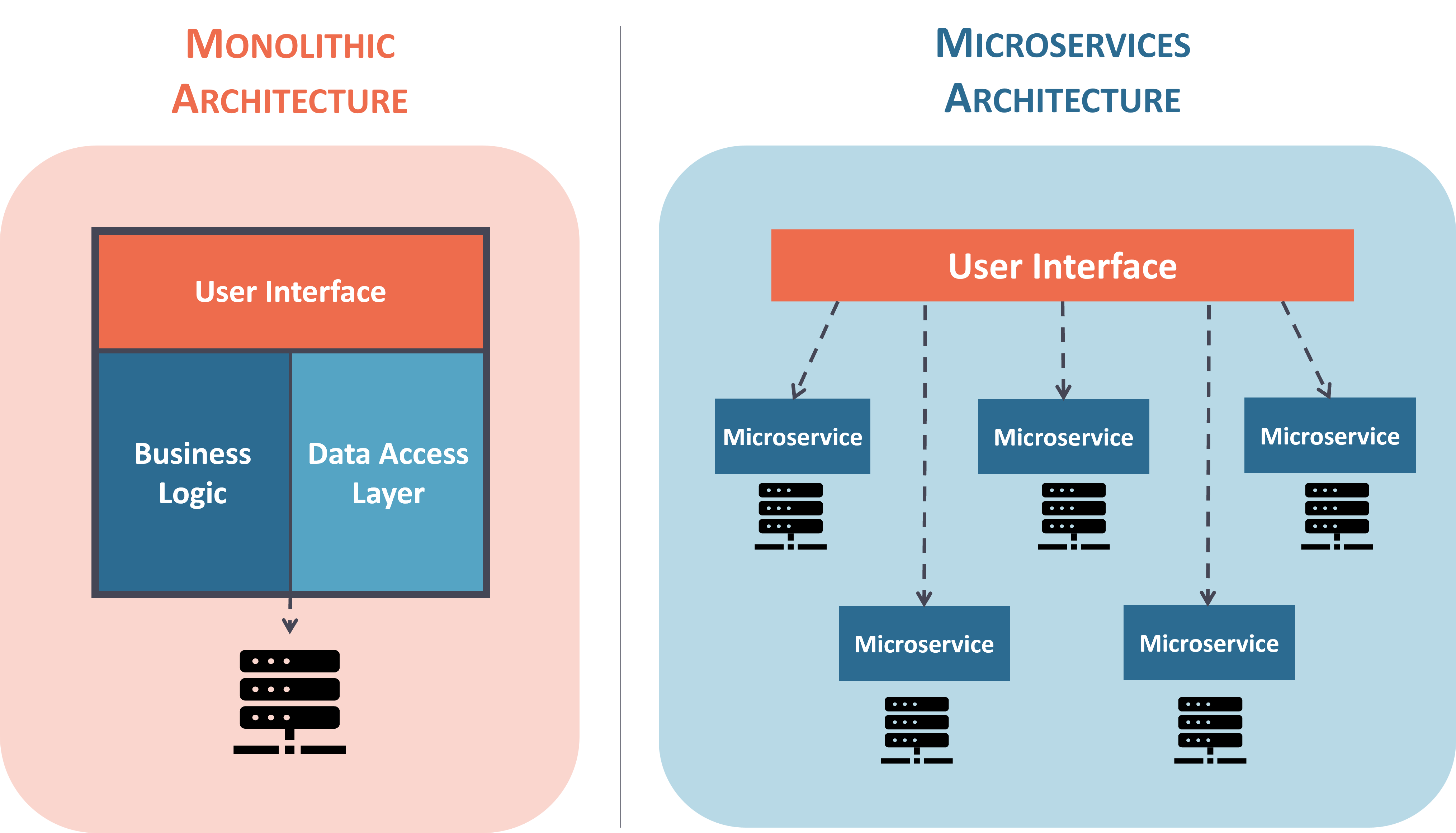
In software development, monolithic architecture refers to building applications as a single, self-contained unit. All components, such as user interfaces, business logic, and data access layers, are tightly coupled and run as a single process. On the other hand, microservices architecture divides applications into smaller, independent services that handle specific business functionalities. These services can be developed, deployed, and scaled independently, promoting flexibility and scalability.
An illustrative example of a microservices architecture is a typical e-commerce platform, such as a web shop. This architecture consists of several microservices, including User, Catalog, Cart, Order, Payment, and Shipping services. Instead of bundling all the business logic together, the architecture divides it naturally based on functionality. Each of these microservices operates independently and focuses on a specific business domain. They communicate with each other using lightweight protocols, such as RESTful APIs or message queues.
In a microservices architecture, data management is also decentralized. Instead of relying on a single monolithic database, each service is in charge of managing its own data and has its own storage. For instance, the User service handles user registration, authentication, and profile management. It stores user information securely and manages authentication requests from other services. Similarly, the Catalog service handles all aspects of the product catalog. It takes care of adding new products, updating product information, and retrieving detailed product descriptions.
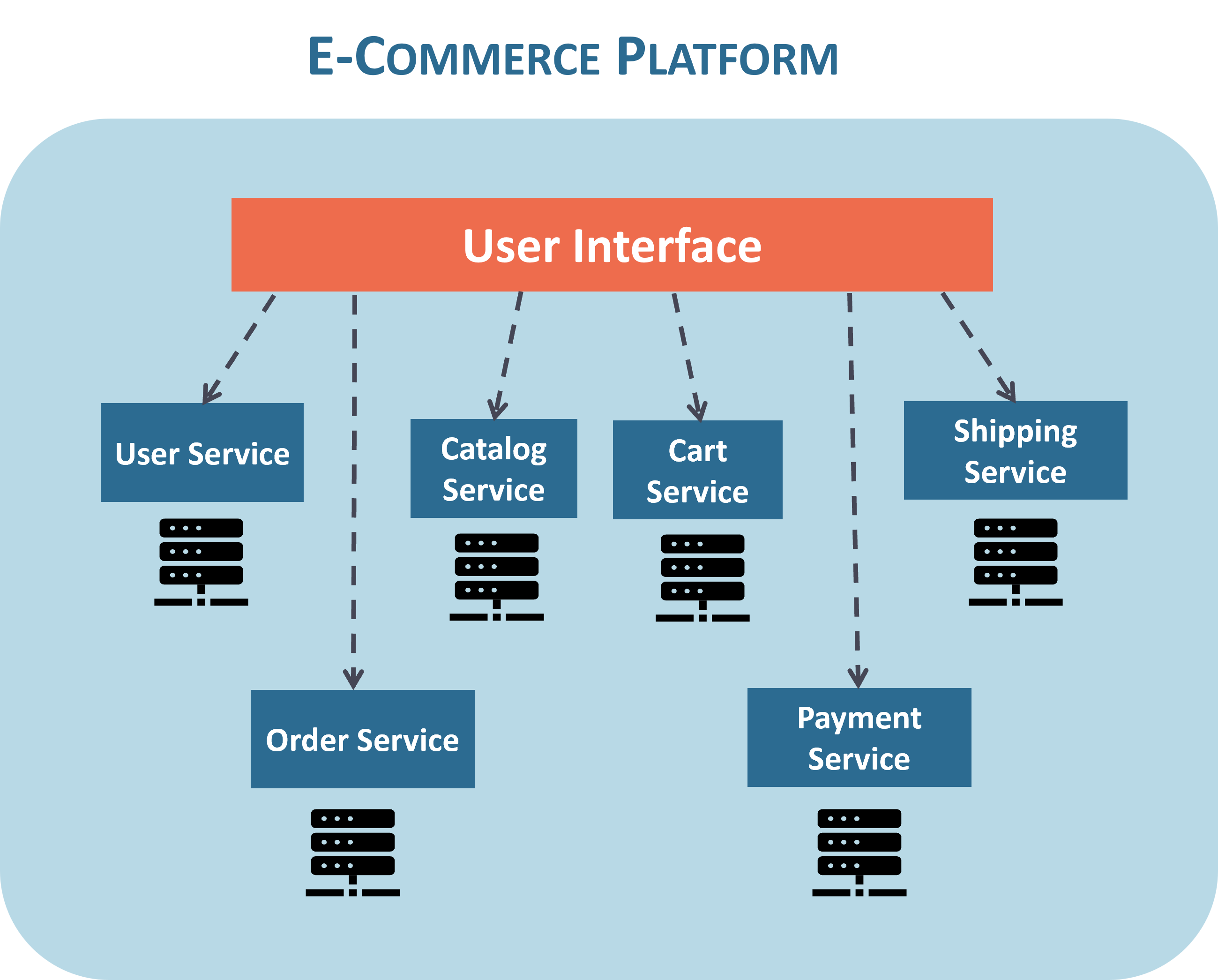
By adopting a microservices approach, the e-commerce platform gains several advantages. It allows for granular scalability, fault isolation, and easier maintenance. Teams can work independently on specific services, leading to faster development cycles and the ability to scale individual components as needed. This decentralized architecture empowers businesses to adapt, evolve, and provide a seamless shopping experience for their customers.
The Power of Kubernetes Orchestration
In the context of microservices deployment, using an orchestration tool like Kubernetes plays a crucial role in simplifying the management of containerized applications. As the number of microservices increases, so does the complexity of deploying and managing them individually.
Kubernetes is an open-source tool that provides a robust framework that automates and streamlines the deployment, scaling, and management of microservices. It abstracts away the underlying infrastructure complexities, allowing developers to focus on building and releasing their applications.
Here’s how Kubernetes brings it all together:
-
- Containerization: Kubernetes leverages containerization technology to encapsulate applications and their dependencies into portable containers. This ensures consistent deployment across different environments, making applications more reliable and scalable.
-
- Deployment and Scaling: With Kubernetes, defining the desired state of an application becomes effortless. Through configuration files, developers specify the desired characteristics of their applications, and Kubernetes takes care of deploying and managing the necessary containers to achieve that state. Automatic scaling based on resource usage further optimizes application performance and resource allocation.
-
- Service Discovery and Load Balancing: In a microservices architecture, multiple instances of services may run concurrently. Kubernetes provides built-in mechanisms for service discovery, assigning unique IP addresses and DNS names to each service. It also intelligently distributes incoming traffic across the service instances, ensuring efficient load balancing.
-
- Resilience and High Availability: Kubernetes prioritizes application resilience and high availability. It constantly monitors the health of containers and nodes, automatically restarting failed containers or rescheduling them to healthy nodes. This self-healing capability minimizes downtime and enhances application reliability.
-
- Observability and Monitoring: Monitoring containerized applications becomes seamless with Kubernetes. It integrates with various tools to collect and centralize logs, set up health checks and metrics, and gain insights into application performance. This enables businesses to proactively identify and address issues, ensuring optimal application performance.
-
- Configuration and Secret Management: Managing application configurations and sensitive information is made easy by Kubernetes. ConfigMaps and Secrets allow for the storage and injection of configuration data and secrets into containers. This simplifies environment-specific configurations and enhances security by securely managing sensitive data like API keys and database credentials.
Embracing Kubernetes for Future Success
For businesses seeking to stay competitive and innovate, embracing Kubernetes as a strategic technology choice is crucial. Its ability to seamlessly handle microservices architectures empowers organizations to achieve accelerated development and deployment, enhance scalability and resource utilization, and improve reliability and fault Isolation.
Karleo offers solutions for deploying big-data services on Kubernetes with minimal to no-code approach so that you can bid farewell to the arduous task of manually writing complex Kubernetes configuration files, which traditionally demanded in-depth knowledge of each specific service’s deployment intricacies. Our solutions simplify the entire process, enabling teams to swiftly deploy services without getting tangled in the web of Kubernetes documentation.
By eliminating the need for manual configuration, the deployment process is accelerated, providing a significant boost, particularly during the early stages of development. Teams can swiftly experiment with different technologies, bypassing the complexities of traditional Kubernetes deployment.
The streamlined workflow allows users to focus on core functionality and performance, allocating more time to iterate and fine-tune their big-data services. It ultimately empowers users and businesses to expedite workflows, reduce development cycles, and explore a wide range of technologies with ease. By saving time on Kubernetes configuration, teams can make informed decisions, foster innovation, and deliver exceptional big-data services on Kubernetes.