

How Advanced Tech and AI Drive Situational Awareness
Situational awareness, a concept first explored in human psychology by Mica Endsley in the late 1980s, breaks down into three parts: noticing what’s happening around you, making sense of it, and predicting what’s likely to happen next. This kind of awareness is key to making quick, informed decisions, especially when things are changing fast or there’s potential danger.
As we hand more control over to machines, it’s becoming just as important for them to develop a similar kind of awareness. Thanks to advanced AI technologies like computer vision and language models, machines can now do more than just run autonomously—they can help us by watching for risks, predicting outcomes, and sounding the alarm when something’s wrong. Whether it’s in traffic management, industrial settings, or airport safety, AI is stepping in to monitor, predict, and protect.
Data in, insight out
In computer systems, situational awareness means being able to see what’s happening, understand it, and respond effectively—especially in areas like cybersecurity and IT operations. By pulling in data from various sources, these systems provide real-time insights that help teams take immediate action. This process follows three steps: noticing what’s happening (perception), making sense of it (comprehension), and predicting what might happen next (projection).
In the cybersecurity area, data from network traffic, system logs, and telemetry help create a real-time snapshot of the environment. AI tools like SIEM and IDS then step in to analyze this data, spotting patterns and anomalies that might signal a security threat. With this knowledge, systems can predict future risks and take proactive measures, like stopping potential attacks before they happen.
Across many sectors, situational awareness is key to managing safety and efficiency. In traffic management, these systems track vehicles, detect violations, and predict traffic flow to prevent issues. In industrial settings, they monitor equipment and conditions to ensure everything runs safely. At airports, advanced systems keep runways clear, detect debris and bird strikes, and secure restricted areas through constant surveillance.
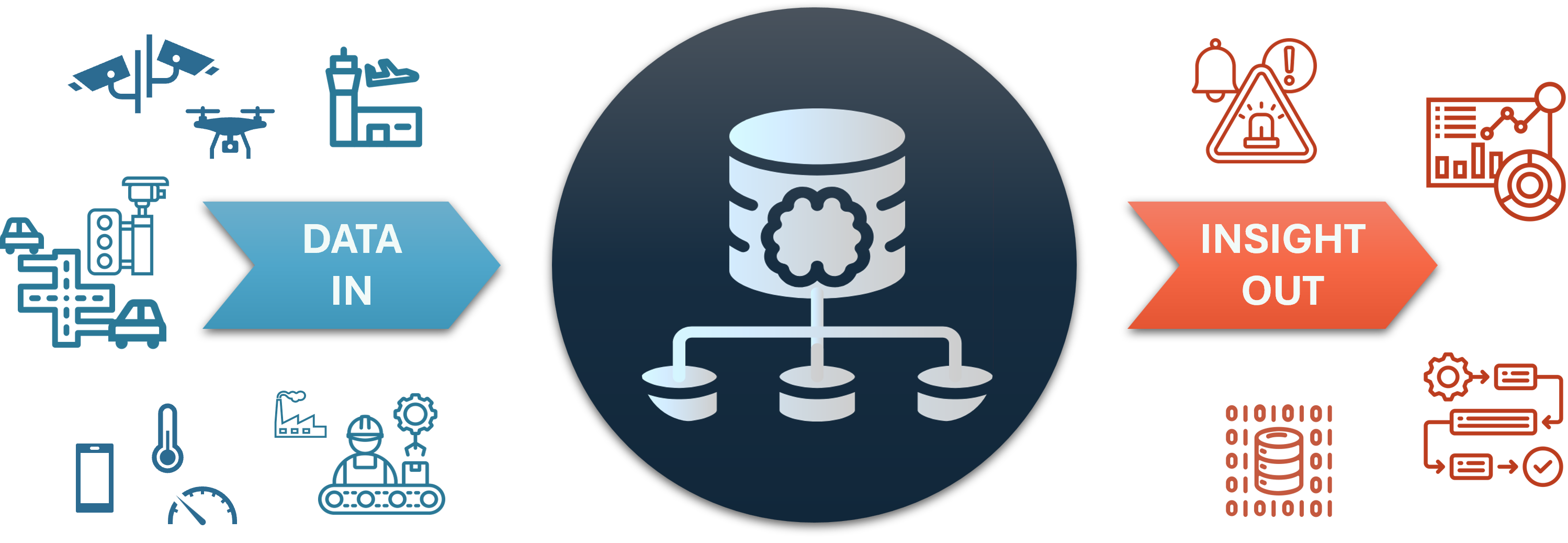
Situational awareness software unifies diverse data streams into a single operational view, providing real-time insights and enabling data-driven, actionable decisions.
Leveraging AI, Cloud, and Edge/IoT
Implementing situational awareness in computer systems comes with several challenges. While gathering data is easier than ever, the real struggle lies in making sense of it and predicting what’s next. The flood of data from different sources can be overwhelming, and if systems aren’t well-connected, it’s hard to see the bigger picture. Integrating this data to create a unified view takes significant resources and expertise. Real-time analysis adds another layer of complexity, with issues like latency and compliance slowing down decision-making. On top of that, outdated systems, limited budgets, and the shortage of skilled professionals make it even harder to maintain effective situational awareness.
Recent advances in AI – especially in areas like computer vision and generative AI—are changing the game for situational awareness in computer systems. Thanks to machine learning, these systems can now handle massive amounts of data, spot patterns, and detect unusual behavior, making them essential for better threat detection and faster responses. Machine learning also helps automate tasks, cut down on false alarms, and predict future risks, keeping systems ahead of emerging threats.
Computer vision plays a big role by analyzing visual data in real-time, like security footage or biometric scans, to catch things like unauthorized access or tampering. Meanwhile, generative AI adds another layer by creating synthetic data to train models, simulating potential attacks, and improving phishing prevention. It even helps streamline incident response, making communication between security teams and systems more efficient.
Building large-scale situational awareness systems relies on a mix of cloud computing and edge/IoT infrastructure. The cloud offers the scalability and flexibility needed to handle huge amounts of data and respond quickly to security issues. It pulls together data from different sources, making it easier to analyze, and uses AI to uncover insights. Plus, cloud platforms help teams collaborate from anywhere and come with built-in disaster recovery and security tools, making them a key piece of any strong situational awareness setup.
On the other hand, edge computing handles data processing closer to where it’s generated, like on IoT devices, which reduces delays and allows for real-time awareness. This local processing means threats are detected faster, and systems stay resilient even if the cloud connection drops. Edge computing also boosts security and privacy by limiting how much sensitive data gets sent to the cloud, and it can be tailored to fit specific industry needs.
By combining the cloud’s scalability with the edge’s speed and localized processing, organizations can create a powerful system that keeps situational awareness sharp across different environments.
Challenges
While technologies like AI, cloud, and edge computing greatly enhance situational awareness, they also come with their own set of challenges. Ensuring data quality, addressing biases in AI models, and managing new security risks are all crucial hurdles.
One key challenge is making sure that front-line personnel have a clear, personalized view of the information they need. A one-size-fits-all approach doesn’t work—each team member needs a dashboard that’s tailored to their specific role, responsibilities, and location. This personalized view ensures that everyone has access to the right data at the right time, empowering them to make better decisions in the moment.
Another challenge is integrating new technologies with existing operational systems. Many organizations still rely on legacy systems and processes, and blending these into a seamless, user-friendly dashboard can be complex. However, once achieved, it allows front-line employees to quickly access critical information and provide customers with better service.
There’s also the issue of network reliability. As situational awareness systems become more dependent on network communications, not every area has access to the high-speed 5G networks needed to support real-time operations. On top of that, with increasing internet traffic, ensuring that the network doesn’t become a bottleneck is essential for keeping systems running smoothly.
Finally, the environmental impact of large data centers supporting these systems can’t be ignored. Data centers consume massive amounts of energy, and balancing that with the need to improve energy efficiency in the systems controlled by situational awareness software is crucial for reducing the environmental footprint.
Conclusion
When done right, situational awareness software can provide a game-changing leap in how organizations see and understand their operations. It’s not just about keeping tabs on what’s happening—it’s about gaining a whole new level of visibility that enables smarter, faster decisions. But for this to truly transform the way organizations work, the software has to be flexible, scalable, and interoperable. It needs to adapt to different environments, grow as your needs evolve, and seamlessly integrate with existing systems.
The most effective situational awareness solutions don’t just solve today’s problems—they’re designed to evolve, extend, and continue delivering value as new technologies and challenges emerge. When these elements come together, situational awareness becomes more than just a tool – it becomes the foundation for a more responsive, efficient, and forward-thinking organization.